How Aspies Think, Why We Do Weird Stuff, and Why We’re Important
 Imagine being in a strange country where you don’t understand the mores – and aren’t aware you don’t understand them. Say, waiting for scrambled eggs to show up for breakfast in Tel Aviv (They eat salad for breakfast), or saying a friendly “Hi” to young indigenous men in the jungles of Ecuador, wondering why they then followed you in a pack (Looking into a man’s eyes means a woman is ready for sex.).
Because events get interpreted uniquely by different cultures, people like me on the Spectrum are sort of stuck: NeuroTypicals (NTs) make the rules. And from my vantage point they are crazy.
DIFFERENT STROKES FOR DIFFERENT FOLKS
As an Aspie, my internal rules, my assumptions, my responses, and my perceptions are different from a NTs. I hear metamessages (unspoken assumptions) primarily and content secondarily; I respond according to what the Speaker intended (often unspoken) rather than what my (biased) ears interpret. I think in systems, in wholes and experience the world in patterns, not sequences and details as NTs prmarily do.
NTs seem to operate using rules that fit a norm I cannot fathom. Yet somehow, with the majority of humans on the NT scale, there’s agreement that those rules make sense. In my mind, they don’t.
Why should I reply “Fine, thanks. How are you?” when someone asks how I am? It’s a real question that should be answered with how I’m faring, right? If they don’t want to know how I am, why did they ask? And how did it get agreed that a meaningless exchange is an authentic greeting? I’ll never understand.
Why am I labeled inappropriate when I respond to something differently than ‘expected’, and sometimes an interesting add-on to what’s been said? Who says NTs are the ones who understand accurately? Maybe my references and responses are the correct way of seeing. Maybe my references and responses are a great ‘add’ to a conversation that expands the scope of the subject. Maybe my comments are worthy of curiosity.
Why am I the one being too direct? Why aren’t NTs more honest?
Why am I the one who’s deemed too intense? Why are NTs so superficial?
I recently watched my 7 year old friend throw a small toy across the room where his four younger sibs played on the floor. Stop throwing that, said Dad, afraid the little ones might get hurt. My friend again threw the toy. Stop, or I’ll take it away, said Dad. Again, the toy went across the room. Give me that. No more toy.
I said to my young friend, “Your dad was afraid the toy might hurt your brothers and sister. What were you hoping to accomplish by throwing that toy?”
“I wanted to understand how it was spinning.”
“So next time, tell Dad what you want to do and he’ll let you go outside to throw it.” Why didn’t Dad get curious? Why was removing the toy without understanding the reasoning the only option? This was a clear case of NT’s and Aspies considering different aspects of the same problem – something that happens far too frequently in my world.
THINKING IN SYSTEMS LEADS TO MORE CREATIVITY
My Aspie brain perceives a wholly different culture from the world of NTs, with different expectations, referents, assumptions, thinking systems, rules, and interpretations. My systems thinking and different understanding of what’s happening has enabled me to develop new models for conscious choice, different from the long-held biases and assumptions built into behavior change-based conventional business, personal, and healthcare models.
Indeed, with my ability to see, hear, and notice largely unconscious systems, I have devoted my life to unraveling, (de)coding, and inventing models for change in a way that gets to the unconscious systems that generate values-based decisions so change becomes easy and everyone can make congruent choices.
-
- I recognized that selling doesn’t cause buying and the sales model merely places solutions, overlooking the Pre-Sales change /risk management issues involved when anyone seeks to resolve a problem. I invented Buying Facilitation® 40 years ago to enable sellers to find and lead prospects through their decision making (13 stages) before selling.
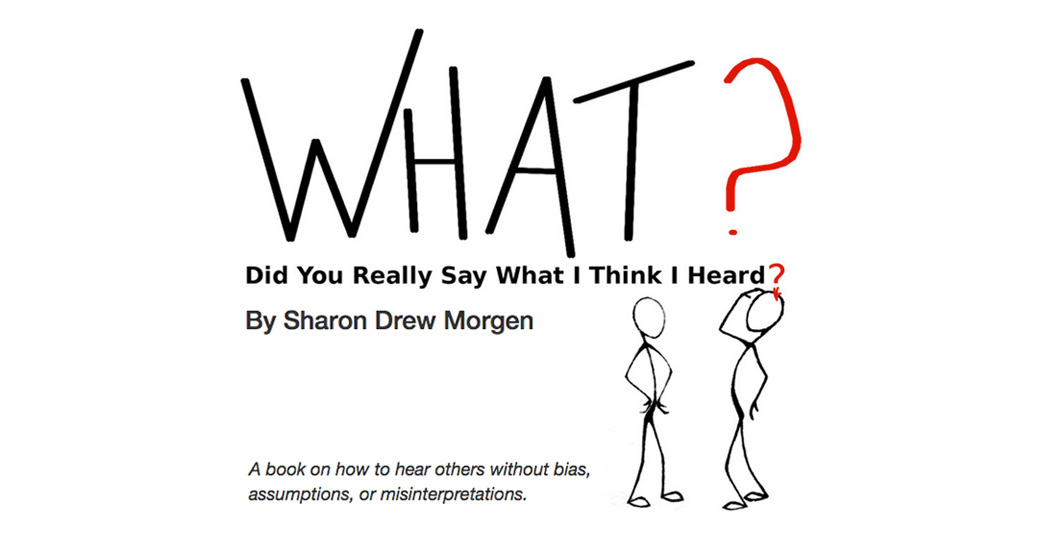
- Because of the way I listen I clearly recognize the gap between what’s said and what’s heard. I developed a road map so people can hear each other without bias and wrote a book on it.

- People make decisions via their unconscious mental models and habitual neural pathways. Yet influencers merely lead Others to where the influencers think they should look, rather than where in their brains Others hold their own answers. I developed a new form of question (Facilitative Questions) that facilitates others through to where their own values-based answers are stored.
- I noticed that people seeking to change behaviors had trouble maintaining their changes because real change involves generating wholly new synapses/pathways. I’ve successfully trained many thousands of people to change habits and behaviors permanently via discovering, and consciously managing their unconscious brain circuitry.
- The training model offers content, assuming, incorrectly, that learners will accurately hear, understand, and store the incoming knowledge. I designed Learning Facilitation, an addition to standard training that enables brains to house, retain, and understand the new knowledge.
- I noticed how change agents, healthcare providers, coaches and leaders posed biased questions to promote change and modify behaviors. I developed a model that enables Others to change habits and behaviors permanently by getting into their own neural systems to make change.
Thinking in systems has it possible for me to develop models I’ve trained to 100,000 people globally. Yet I continue to be judged negatively against the norms of the NT world.
How, I wonder, does the world change unless the outliers like me instigate radical change? You can’t do that from the middle. And if more NTs were willing to be curious, look through a different lens, it wouldn’t take people like me decades to instill productive ideas.
RIGHT VS WRONG
So that brings me to my question: How do Aspies end up being the ones who are wrong or on the wrong side of normal? Why? Because my ideas, my speaking patterns, are different? Because they challenge the norm? Why isn’t that exciting? Or fun? Or interesting?
The good news about Aspies is that we’re often pretty smart. Because we think in systems and can see all aspects of something we often are the innovators, the visionaries, who notice, invent, code stuff decades before academics or scientists.
In these days of more openness and a real desire to accept minorities, to communicate and live without bias, maybe it’s time that Aspies are acknowledged as well.
Maybe when NTs hear someone say something that’s a bit off the mark, or rattle on about a topic that’s interesting albeit a bit long winded (We get SO excited by our topics!), maybe they can just say, ‘Hm. Sounds like an Aspie. I wonder what I can learn here. I wonder if I can be curious about something new.’ Then we, too, can have a voice. And just maybe we can become a welcome addition, add our two cents, and maybe make the world a better place because of our differences. Just sayin’.
_____________________________________
Sharon-Drew Morgen is a breakthrough innovator and original thinker, having developed new paradigms in sales (inventor Buying Facilitation®, listening/communication (What? Did you really say what I think I heard?), change management (The How of Change™), coaching, and leadership. She is the author of several books, including her new book HOW? Generating new neural circuits for learning, behavior change and decision making, the NYTimes Business Bestseller Selling with Integrity and Dirty Little Secrets: why buyers can’t buy and sellers can’t sell). Sharon-Drew coaches and consults with companies seeking out of the box remedies for congruent, servant-leader-based change in leadership, healthcare, and sales. Her award-winning blog carries original articles with new thinking, weekly. www.sharon-drew.com She can be reached at sharondrew@sharondrewmorgen.com.

Sharon Drew Morgen February 9th, 2026
Posted In: Communication, News