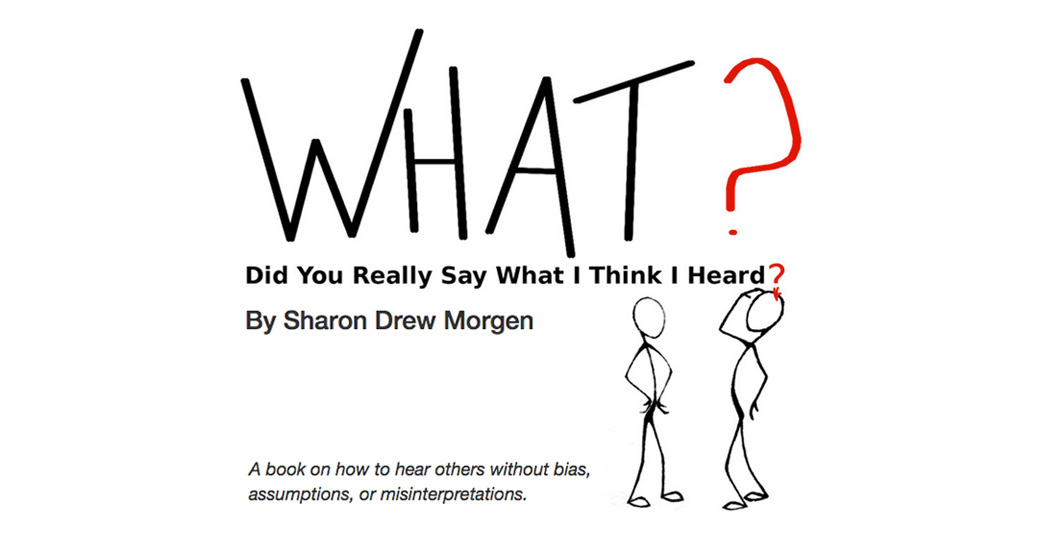
The Importance of Confusion, by Sharon-Drew Morgen
 When I begin an on-site training program I start by saying:
“Hi everyone. I’m so happy we’re together! I’d like to begin with a warning: I use confusion as a teaching tool. Confusion is merely your brain not finding an existing circuit to accept new information. During the first day I will be keeping you in confusion a lot to make sure there’s a way to retain new knowledge to supplement what you already know. So when you’re confused, I’m SO happy!”
The participants laugh uncomfortably. But then it becomes a sort of gentle contest – who can be the MOST confused. Invariably someone says
“Sharon-Drew, you’ll be SO proud of me! I’m SOOOO confused!”
And everyone laughs together and claps in knowing agreement.
WHY IS CONFUSION DEEMED BAD?
I wonder why confusion is something to be avoided. Why do we all have to ‘know’ everything? Why can’t we delight in the mystery, the jumble, the dark moving spaces that bring that slight bit of discomfort, a touch of fear and dollop of curiosity?
When we think we ‘know’ something, it’s because we’re using circuits that already exist in our brains. Sadly, we assume what we ‘know’ is accurate, even if it ends up being inaccurate or biased; even if it means we dismiss new content that might be more accurate; even if it means we restrict learning anything new.
Old beliefs, previous knowledge, habits and assumptions become concretized over time, and new ideas become suspect because there’s no precedent for them even if the new ideas are more cogent. Our brains just love our status quo. Simple. Stable. Quick. Reality? No such thing.
How do new ideas get into the world when they’re contrary to existing myths and norms? Why isn’t ok to be confused and then curious to research, think, debate new ideas?
Entire fields remain committed to researching within the confines of perceived wisdom, even when they suspect, or when they’re known to be ineffective. How does something new enter if confusion, or the ‘unknown’, isn’t considered?
Remember flat earthers? What about radio waves? Did you know only a few of Cezanne’s paintings were purchased during his life? Or that it took 40 years after the invention of the telephone to begin broad use – using Morse Code instead? Are you aware that initially Bill Gates told his team that he wasn’t convinced the internet had value? Seriously.
LISTENING IS PART OF THE PROBLEM
One of the initiators of our confusion is the way words enter our brains to get translated. You see, when we hear someone speak, our brains don’t accurately translate what the speaker intends to communicate!
In fact, we end up accurately hearing a maximum of 35% of what a speaker intends, causing us to unwittingly revert to what we’ve heard before, making learning and retaining something new quite difficult. When we feel confusion, it’s an indication that our brain is having difficulty translating the incoming content. So confusion is a great indication we’re trying to learn.

I adore confusion. It means I’m creating new circuits. It means I’m learning!
WE COULD ALL USE A BIT OF CONFUSION
Our brains are the problem. Indeed, because of the way we subjectively interpret new ideas we end up restricting our lives. Indeed, everything, regardless of what science thinks, or what our spouses or bosses want us to believe is true, is a subjective interpretation!
What we read or enjoy; the colors we see and the words we hear; the friends and jobs and neighborhoods we choose; are restricted to the circuits that already exist in our brains – what we agree with and the worlds our brain circuits have created for us – obviously a carefully calibrated world view; obviously restricting a whole lotta world out there we don’t recognize or enjoy or share. We could all use a little confusion now and again.
To reconsider confusion, to learn, change, and be enriched, here are some questions:
- What would you need to believe differently to be willing to rid yourself from some of your biases? Do you know which ones you’d be willing to part with? How do you know your answer isn’t biased?
- How would you know that any confusion is worth the cost of ‘not knowing’ and being uncomfortable?
- What issues come up for you when you face the prospect of being confused in an area you’re expert in?
- Are there any areas of your life or work knowledge that you protect, that you prefer not to feel confusion around because you believe you have all the knowledge you need – and it’s accurate? Would you be willing to examine these to see if there is anything new to learn? Any areas for you to rethink?
- Think of a topic, an idea that runs counter to your beliefs and spend time with it. No, really. Spend enough time to understand it, and know precisely how it differs from your beliefs. See if you can find any fragment in there that confuses you that you’d be willing to think about for a day or two.
We live our lives, work our jobs, vote and go to neighborhood meetings, accustomed to having an automatic answer, knowledge at the ready that has been vetted by our brains, accepted and comfortable. But to gain new knowledge, reconsider old opinions, mature your beliefs and self-asessments, you can create new circuits, and then have a whole new knowledge set.
All you need is some curiosity and the willingness to be confused for a bit of time. You’re worth it, no?
_______________________
If you’re enjoying these Monday Articles, please subscribe to make sure you get them delivered to your inbox on Monday morning. I use no cookies, they’re free, and I never use the database to market. As an original thinker I offer these to share out-of-the-box ideas as part of my life’s work. And I’m always eager to hear your thoughts and start a conversation: sharondrew@sharondrewmorgen.com. Enjoy.
_______________________
Sharon-Drew Morgen is a breakthrough innovator and original thinker, having developed new paradigms in sales (inventor Buying Facilitation®, listening/communication (What? Did you really say what I think I heard?), change management (The How of Change™), coaching, and leadership. She is the author of several books, including her new book HOW? Generating new neural circuits for learning, behavior change and decision making, the NYTimes Business Bestseller Selling with Integrity and Dirty Little Secrets: why buyers can’t buy and sellers can’t sell). Sharon-Drew coaches and consults with companies seeking out of the box remedies for congruent, servant-leader-based change in leadership, healthcare, and sales. Her award-winning blog carries original articles with new thinking, weekly. www.sharon-drew.com She can be reached at sharondrew@sharondrewmorgen.com.

Sharon Drew Morgen August 31st, 2026
Posted In: News